On November 4, New York elected its new mayor, Zohran Mamdani. At age thirty-four, Mamdani identifies as a “democratic socialist.” His victory signals a further leftward shift in New York’s political center of gravity. His proposed governing agenda goes beyond the traditional policies of the Democratic Party and moves toward a more radical and “equitable” program.
The core theme of Mamdani’s campaign was the cost-of-living crisis faced by New York’s working class. His promise was to “make New York affordable again.” Accordingly, his platform included: a rent freeze prohibiting landlords from raising rents; free public transportation and free childcare; and substantial tax increases on high-income earners and wealthy households.
He also proposes raising the minimum wage and building 200,000 units of affordable housing within ten years. To counter rapidly-rising food prices and lower household expenses, Mamdani intends to establish city-run grocery stores. These stores would be non-profit entities exempt from property taxes and rent. In short, he aims to create a New York-style “state-run planned-economy retail network” for the sake of public welfare.
It is clear that Mamdani’s vision of a “New York Commune” relies on heavy regulation and intervention. He seeks to address what he calls “economic inequality” through aggressive wealth redistribution and expanded state involvement in the market. Yet critics—including fellow Democrat and former candidate Cuomo—warn that such policies will trigger an exodus of businesses and high-income residents.
These warnings are not unfounded. According to a J.L. Partners poll cited by the Daily Mail, among New York City’s 8.4 million residents, 9 percent—about 765,000 people—said they would “definitely” leave if Mamdani won. Another 25 percent—roughly 2.12 million—said they would “consider” leaving. Among households earning more than $250,000 per year, 7 percent stated explicitly that they would relocate.
This survey is not merely a statistical sample—it is a direct reaction to the incoming administration’s agenda. Those who believe they are the primary targets of Mamdani’s policies—namely, high earners and heavily taxed groups—are signaling through their responses that they are preparing to “vote with their feet.” As one might say in Chinese: “If I can’t afford to fight this, I can at least avoid it.”
After Mamdani’s victory, former President Barack Obama posted on X: “Congratulations to all the Democratic candidates who won tonight. It’s a reminder that when we come together around strong, forward-looking leaders who care about the issues that matter, we can win. We’ve still got plenty of work to do, but the future looks a little bit brighter.”
Obama clearly views his administration—and Democratic governance more broadly—as successful and hopeful. But whether this optimism is justified is debatable. One of the most revealing indicators comes from interstate migration data across the United States.
The logic is simple: people seek better places. If a state’s economy, politics, education, or culture becomes intolerable, leaving is the natural response. In this sense, “voting with one’s feet” is the most authentic form of voting. Indeed, foot-voting is often more truthful than ballot-voting.
With this in mind, consider the data on domestic migration within the United States. According to the US Census Bureau’s net domestic migration statistics from July 2023 to July 2024—defined as inbound minus outbound residents, excluding international migration and natural population change—the contrast is striking.
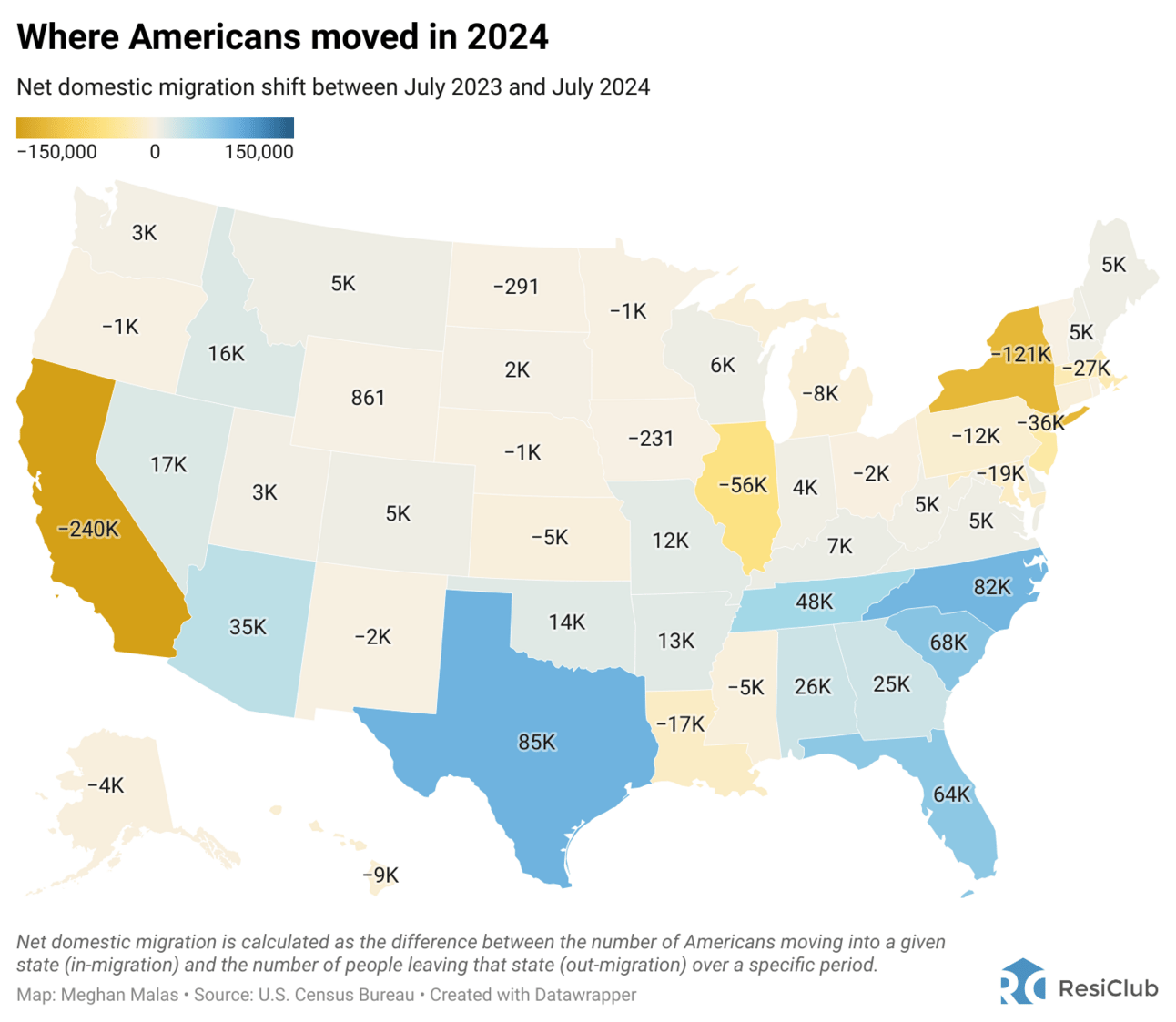
The states with the largest population losses were all “blue states”:
• California: –239,575
• New York: –120,917
• Illinois: –56,235
• New Jersey: –35,554
• Massachusetts: –27,480
By contrast, the states with the largest population gains were mostly red or right-leaning states:
• Texas: +85,267
• North Carolina: +82,288
• South Carolina: +68,043
• Florida: +64,017
• Tennessee: +48,476
The pattern is unmistakable: the five states with the highest net in-migration are all red states known for low taxes and lower living costs. Meanwhile, the three major “deep blue states” with the largest out-migration—California, New York, and Illinois—are characterized by high housing costs, high taxes, and high living expenses. Much of this burden stems from the heavy regulation typical of Democratic governance.
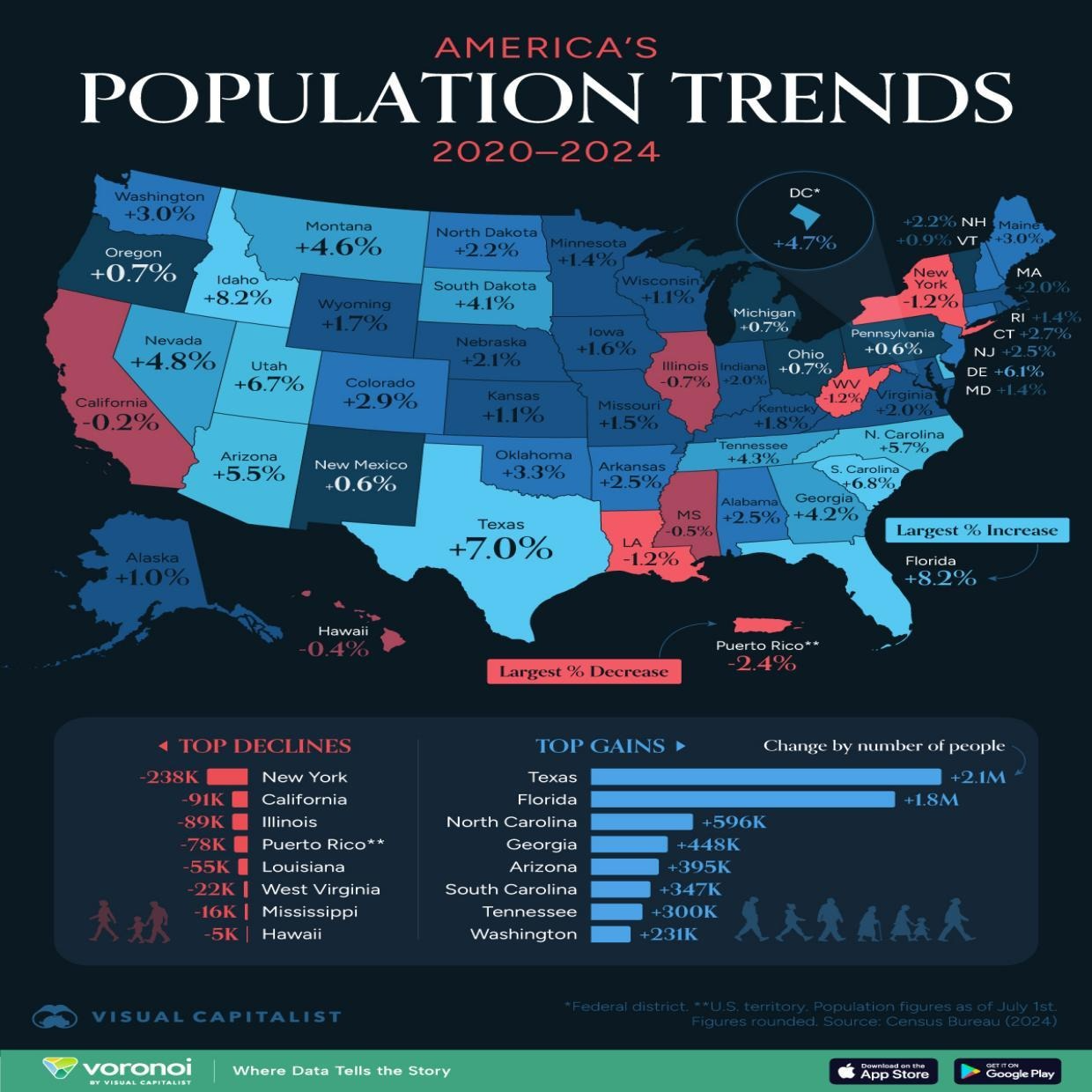
If one year of data seems insufficient, consider the numbers over the past five years. From 2020 to 2024, the states with the greatest population decline were again Democrat-run blue states:
• New York: –238,000
• California: –91,000
• Illinois: –89,000
On the growth side, Texas (+2.1 million) is a traditional Republican stronghold; Florida (+1.8 million) has in recent years become a reliably red state; and North Carolina (+596,000) is often considered a swing state, with a Democratic governor but a Republican-controlled legislature.
Stretching the timeline further, a comparison between 2005 and 2022 reveals an even deeper asymmetry. Total out-migration from blue states rose sharply—from 3.7 million in 2005 to 4.6 million in 2022. Meanwhile, out-migration from red states remained almost unchanged, increasing only slightly from 3.3 million to 3.6 million.
Clearly, whether viewed over one year, five years, or eighteen years, the pattern is consistent: the low-tax, low-regulation “red state model” retains and attracts residents, while the high-tax, high-regulation “blue state model” increasingly drives its tax base away. People are voting with their feet.
Returning to Mamdani’s victory: his call to “tax the rich” is not mere rhetoric. The J.L. Partners poll is compelling evidence. It represents the first measurable sign that New York’s shift into a new phase of “democratic socialism” is prompting its residents—especially its tax contributors—to run for the exits.
Population movement is the most honest voting system a city, state, or nation possesses. Ballots can be swayed by emotion, but migration cannot. People do not relocate for ideology, but they do move for better living conditions, lower taxes, more opportunities, safer streets, and better schools. Governance quality is ultimately revealed through people’s physical choices, just as preferences are demonstrated through actions.
New York today is not merely facing a shift in policy under a new mayor—it is confronting the structural consequences of its long-standing policy trajectory. Mamdani’s election is not the cause of New York’s deterioration; it is a symptom of a population “great divergence” that has already occurred.
However, his victory and the policies he represents are likely to act as accelerators for the next wave of population and capital flight. Without institutional checks to interrupt this feedback loop, deep-blue centers like New York will continue to experience structural, predictable decline in their economy, finances, and population.